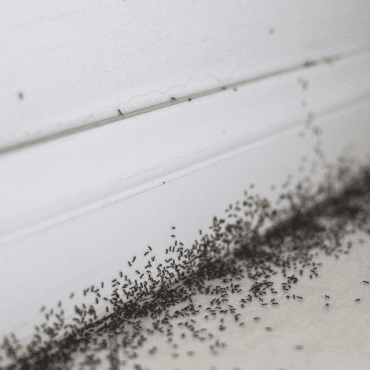
Ants are one of the most common pests found in UK homes and businesses. While small in size, they can quickly become a big problem once a colony establishes itself. Ants are highly organised, living in large colonies with worker ants constantly searching for food. Once they locate a source, they leave a trail that attracts even more ants, leading to a fast-growing infestation.
Inside properties, ants are often seen in kitchens, cupboards, and food storage areas. Outdoors, they nest in soil, paving, or walls, and can easily travel inside. Some species, such as black garden ants, are more of a nuisance, while others, like pharaoh ants, can pose health risks by contaminating food surfaces.
Which Ants Are You Dealing With
The black garden ant is the ant you are most likely to meet. In the Royal Society of Biology's national flying ant survey, close to 90 per cent of the flying ants recorded were this one species. It nests outside, in soil, under paving slabs and at the foot of walls, and sends workers indoors along a scent trail once they find food. Because the nest is usually outside the house, wiping out the trail you can see does little, and treatment has to reach the colony itself. Our guide on whether pest control removes the nest or just sprays explains why.
Pharaoh ants are a different job. They are a tiny tropical species that in the UK lives only in large, centrally heated buildings such as blocks of flats, hospitals and bakeries, often close to boilers and ovens. A colony that feels threatened can split into new colonies and spread through a building, so they need careful surveying and specialist baits, and clearing them can take several months.
When and Where Ants Are Active
The RHS gives April to October as the months ants are most active. Outdoors they nest in lawns, flower pots, compost bins and among plant roots, and small heaps of fine soil on the surface are often the first sign of a nest below. A nest under a path or against the house gives workers a short route indoors.
Winged ants appear in summer, and the swarms are a mating flight. The males die soon afterwards and the new queens go off to start colonies of their own. The Royal Society of Biology's flying ant survey found that ants only fly when it is warmer than 13°C and the wind is light, and that flying ants were reported somewhere in the UK on up to 96 per cent of days between June and September. So there is no single flying ant day, just a run of warm, still days through the summer. We treat ants across Romney Marsh, Ashford and the rest of our area.
Ant Control Process
We use a proven ant control process designed to remove infestations and prevent them from returning.
01 Ant Control Inspection
A trained pest control technician will visit your property to identify the type of ant present, where the nests are located, and the extent of the infestation. We also look for entry points and factors that may be encouraging ants into your property. After the inspection, you'll receive a tailored treatment plan suited to your situation.
02 Ant Control Treatment
Our team uses targeted treatments that work at the source of the problem, the nest itself. This ensures the entire colony, including the queen, is dealt with. Treatments may include specialist gels, sprays, or granules that ants carry back to the nest, eliminating the colony over time. We focus on safe, effective methods that deliver long-term results.
Preventing Future Ant Problems
Once an infestation has been treated, it's important to take steps to stop ants coming back. A few simple prevention measures can make a big difference.
- Keep food sealed in airtight containers and clean up spills quickly.
- Regularly wipe down kitchen surfaces to remove crumbs and sticky residues.
- Empty bins often and make sure they are tightly closed.
- Seal cracks and gaps around windows, doors, and skirting boards where ants may enter.
- Keep outdoor areas tidy by trimming vegetation and avoiding piles of wood or debris close to your property.
By following these steps alongside professional treatment, you can greatly reduce the risk of ants returning to your home or business. If they do return please get back in touch.