
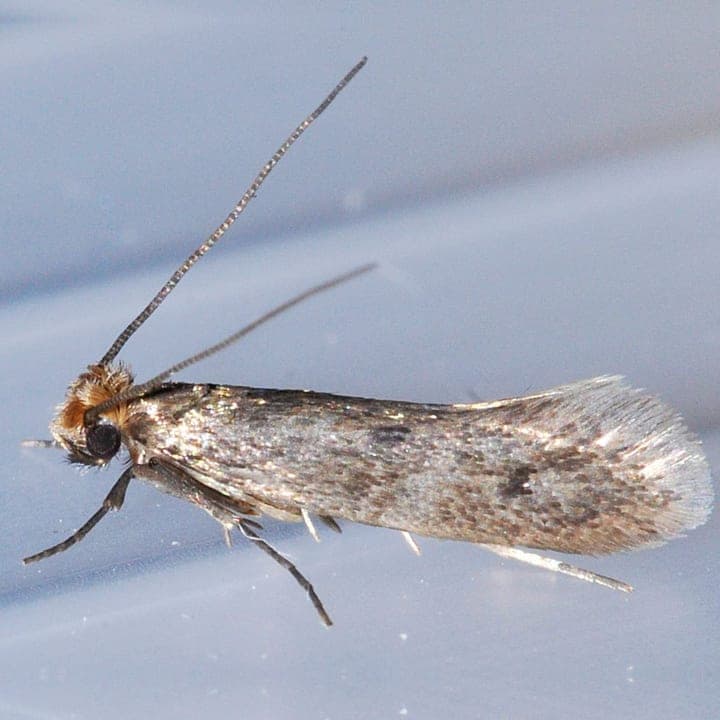
Clothes moths damage wool, cashmere, fur and feathers, and the damage is done entirely by their larvae. The adult moths you see fluttering out of a wardrobe do not feed at all. Every hole in a jumper and every bare patch in a carpet is made by small white larvae feeding out of sight in dark, undisturbed places. Depending on warmth and food, a larva can take anywhere from a month to two years to develop, so an infestation often builds for a long time before anyone notices it.
Two species cause most of the damage in UK homes, the common or webbing clothes moth and the case-bearing clothes moth. Both go for wool carpets and underlay, rugs, clothing, blankets and upholstery stuffed with wool or horsehair, and both prefer items that are stored away or slightly soiled. Look for irregular holes, thinning patches of carpet under furniture or along the edges of a room, fine silk webbing or small silken cases, and small golden moths that scuttle across fabric rather than fly. Our guide to the signs of moths explains what to look for in more detail.
Not every moth indoors is a clothes moth. Moths in a kitchen cupboard are usually food moths such as the Indian meal moth, whose larvae live in dried food like flour, cereals, nuts, dried fruit and dry pet food, leaving silk webbing in the packet. They do not damage clothes or carpets, and dealing with them starts with finding and throwing away the infested food. Identifying the moth correctly at the start decides where the treatment goes.
Moth Control Process
We follow a clear process to find where moths are breeding and treat the problem at its source.
01 Moth Control Inspection
Our pest control technician will identify which moth you have and track down where the larvae are feeding. That means looking well beyond the clothes with holes in them, checking carpet edges, under beds and heavy furniture, inside wardrobes and drawers, and any textiles stored in spare rooms.
Clothes moths naturally live in old bird nests, so we also check the loft, eaves and chimneys for nesting material. That matters in the period homes, oast houses and barn conversions around Tenterden, Canterbury and the Ashford villages, where large roof voids give birds plenty of room to nest. English Heritage's national clothes moth survey, run in 2017 and 2018, found the highest numbers in London and the South East, and more in older homes with voids, fireplaces and attics than in modern ones. Once we know how far the problem has spread, we give you a clear treatment plan for your property.
02 Moth Control Treatment
Spraying the moths you can see does little on its own, because the larvae hide where a spray never reaches. We treat the places they feed, applying a professional residual insecticide to carpet edges, under furniture, inside wardrobes and into the gaps along skirting boards and floorboards. The whole room is treated rather than just the wardrobe, because larvae left in the carpet can move straight back into clothes that have been cleaned. Affected clothing should be washed, dry cleaned or frozen at the same time. Moth control is not quick, and a follow-up visit may be needed to catch any larvae that hatch after the first treatment.
Preventing Future Moth Problems
Moths thrive where things are left undisturbed, so a few regular habits make a real difference once treatment is complete.
- Vacuum regularly, using the crevice tool along carpet edges and under beds, sofas and wardrobes.
- Wash, dry clean or freeze woollens before storing them. A fortnight sealed in a bag in a freezer at minus 18°C kills every stage.
- Store clothes and blankets in sealed bags or lidded boxes rather than on open shelves.
- Check second-hand rugs, vintage clothing and upholstered furniture before bringing them into the house.
- Have old, disused bird nests cleared from the loft and eaves, and replace any wool lagging with a synthetic alternative.
- Do not rely on lavender or cedar alone. They only repel adult moths, need replacing regularly and do nothing to larvae already in a carpet.
With these measures, alongside professional moth treatment, you can protect your clothes, carpets and furnishings from further damage.